





Discover 7 real companies with competitive advantage strategies you can steal today. Learn practical tactics to outperform rivals and grow your business.
Companies with competitive advantage share one trait: they control something rivals cannot easily copy, whether that is cost structure, brand loyalty, distribution reach, or proprietary technology. Studying these companies gives you a practical map for where to look inside your own business.
This article walks through seven real companies, the specific advantage each one built, and how you can apply the same thinking to your own strategy work. Along the way, we will break down the mechanics behind each advantage, explain why it holds up against competitors, and translate the pattern into questions you can ask about your own company. The goal is not to memorize seven stories, but to walk away with a repeatable way of testing whether something you consider an advantage would actually survive contact with a determined competitor.
What Makes a Competitive Advantage Real (Not Just a Slogan)
A real competitive advantage changes customer behavior or cost structure in a way competitors cannot quickly replicate. A slogan describes what a company wants to be known for, while an advantage describes what actually happens in the market. Plenty of companies claim to have "the best service" or "the highest quality," but claims like these rarely survive scrutiny once you ask a simple question: what stops a competitor from saying the exact same thing tomorrow, and would customers believe them?
The test for a genuine advantage usually comes down to three questions. First, does it produce a measurable outcome, such as lower costs, higher retention, or faster growth, rather than just a feeling of pride internally? Second, would a competitor need significant time, capital, or structural change to copy it, rather than a single marketing campaign? Third, does the advantage still hold if a competitor tries to copy only the visible part without rebuilding the underlying system behind it? If the answer to that third question is no, the advantage is more fragile than it looks.
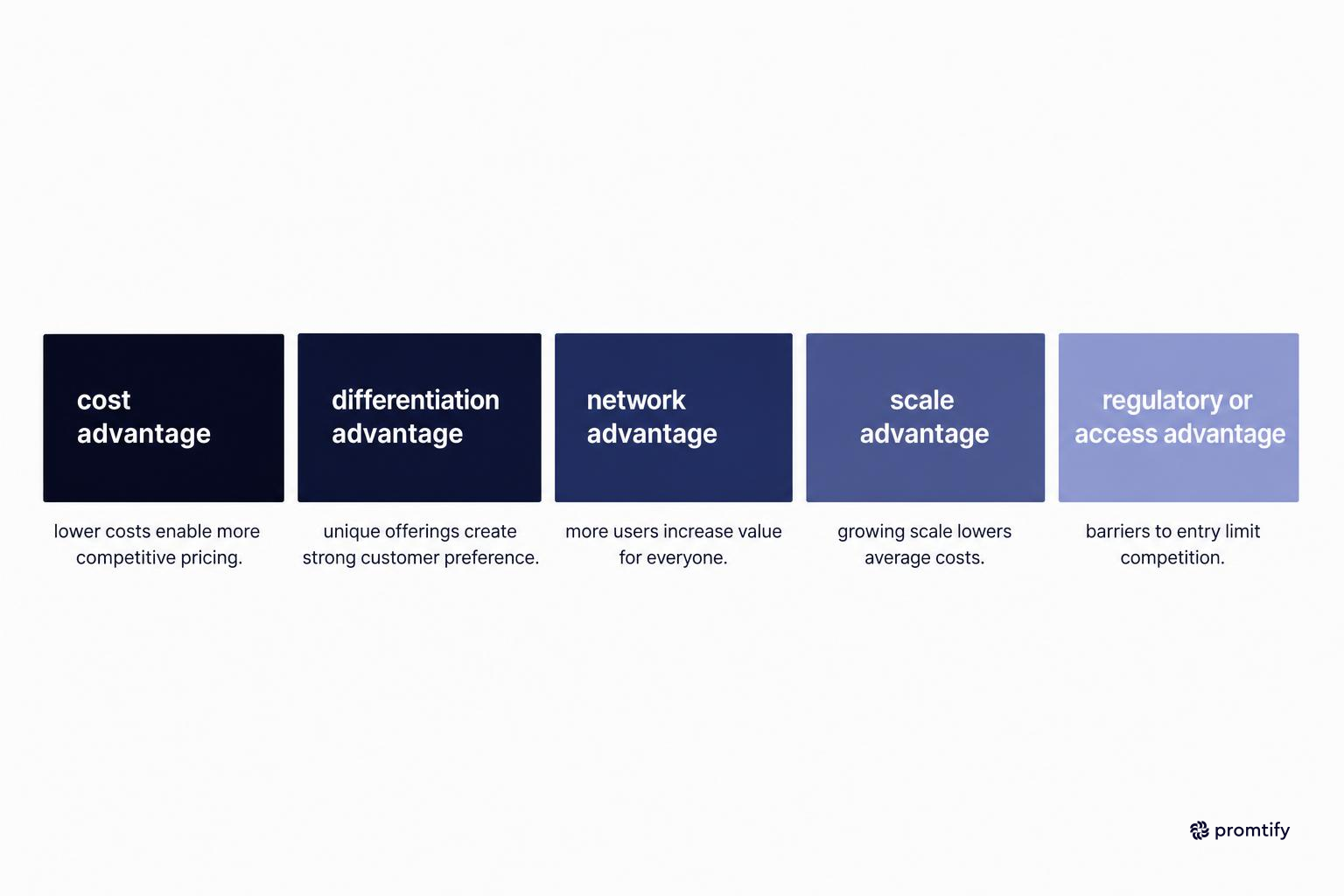
Before looking at examples, it helps to separate advantages into a few recognizable types. Each type tends to show up in different parts of a business, and most companies do not choose their advantage type intentionally at first. It usually emerges from an early decision made for a completely different reason, then gets reinforced over years until it becomes a structural feature of the business rather than a choice anyone actively revisits.
- Cost advantage: The company produces or delivers at a lower cost than competitors, allowing it to price lower while protecting margin. This often comes from scale, process design, or supplier relationships built over a long period, and it tends to compound as volume grows.
- Differentiation advantage: The company offers something distinct enough that customers will pay a premium or stay loyal rather than switch. This can come from product design, brand perception, or an ecosystem of connected products and services.
- Network advantage: The product becomes more valuable as more people use it, making it harder for new entrants to compete. This is common in platforms and marketplaces, where each new user adds value for every existing user.
- Scale advantage: Size itself creates leverage over suppliers, distribution, or data that smaller competitors cannot match. Scale advantages often take the longest to build but are also among the hardest to dislodge once established.
- Regulatory or access advantage: The company holds licenses, patents, or exclusive relationships that legally block competitors from entering the same space. This type of advantage is powerful while it lasts but can disappear quickly if the regulatory environment changes.
Most companies with competitive advantage rely on a combination of two or three of these categories rather than a single one. That combination is often what makes the advantage durable instead of temporary. A company with only a cost advantage can be undercut by an even lower-cost competitor eventually, but a company with both a cost advantage and a network advantage is protected on two fronts at once, which is much harder to attack from any single direction.
Why Studying Competitive Advantage Examples Helps Your Own Strategy
Looking at competitive advantages examples from established companies gives you a shortcut. Instead of guessing at frameworks in the abstract, you can see how a specific decision, made years ago, still shapes a company's market position today. Abstract frameworks are useful for organizing your thinking, but they rarely tell you what an advantage actually looks like when it is working. Real examples fill that gap by showing the mechanism in action, not just the label attached to it.
This matters most when you are trying to identify your own advantage and it feels vague or unconvincing. Comparing your situation against a concrete example of competitive advantage often reveals whether your claimed advantage is defensible or just a preference. If you find yourself describing your advantage in adjectives rather than mechanisms, that is usually a sign you have not yet identified the real structural reason customers choose you over competitors.
There is also a practical benefit to studying multiple examples side by side rather than just one. Patterns emerge once you see several advantages laid out together. You start noticing that cost advantages tend to depend on volume and repetition, differentiation advantages tend to depend on consistency over long periods, and network advantages tend to depend on reaching a certain size before they become self-sustaining. Recognizing these patterns helps you predict roughly how long it might take to build a similar advantage in your own business, rather than assuming it happens overnight.
If you want a broader set of company advantages examples beyond the seven covered here, this example of competitive advantage from leading companies breakdown covers a wider range of industries and advantage types.
1. Costco: Membership Model as a Cost and Loyalty Advantage
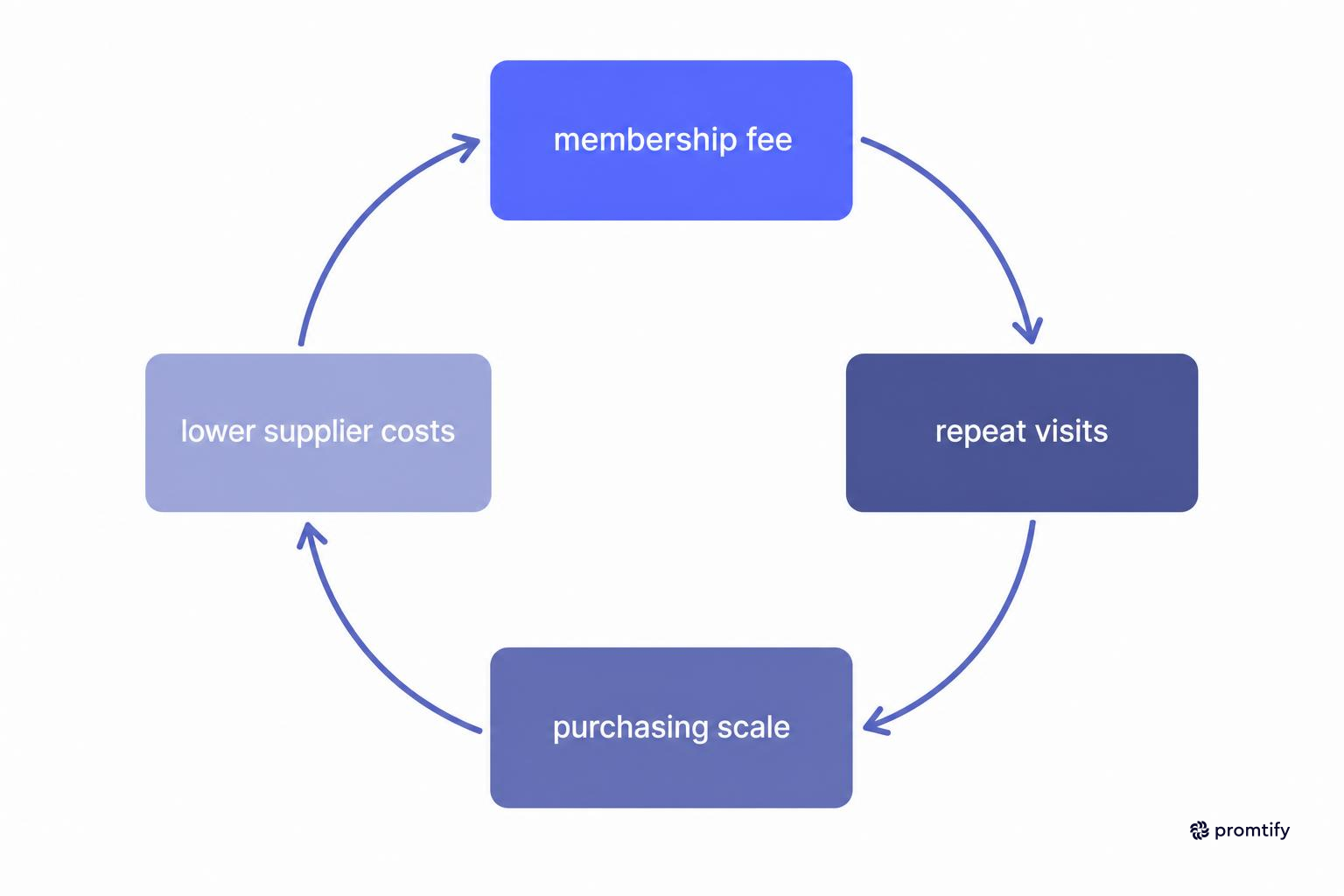
Costco's advantage comes from its membership fee structure combined with a deliberately narrow product selection. Instead of stocking tens of thousands of SKUs like a typical big-box retailer, Costco limits its assortment, which increases purchasing volume per item and gives it stronger negotiating leverage with suppliers. Fewer product lines mean each one sells in much higher quantity, and that concentrated volume is what gives Costco negotiating power that a broader retailer, spreading purchases thin across many products, simply cannot match on a per-item basis.
The membership fee itself changes customer psychology. Once someone pays to join, they feel motivated to shop there regularly to justify the cost, which increases visit frequency and basket size compared to a standard retail relationship. This is sometimes described as a sunk-cost effect: the fee is already spent whether or not the person shops, so the rational move becomes shopping more often to extract value from a cost that has already been paid. Retailers without a membership fee do not get this built-in nudge toward repeat visits.
This combination is difficult to copy because it requires both scale (to negotiate low supplier costs) and an established member base (to sustain the fee model). A new entrant would need years to build either piece, let alone both together. A competitor could try to copy the membership fee alone, but without the purchasing scale behind it, customers would simply see a fee with none of the pricing benefit that makes the fee worth paying in the first place. The two pieces only work because they reinforce each other, which is exactly what makes the model hard to replicate piecemeal.
2. Apple: Ecosystem Lock-In as a Differentiation Advantage
Apple's advantage is not simply product design, though that plays a role. The stronger advantage is the ecosystem connecting hardware, software, and services so tightly that switching away from any single Apple product becomes inconvenient. A well-designed phone can be copied within a product cycle or two, but a fully interconnected ecosystem spanning five or six product categories takes far longer to build and requires sustained coordination across teams that most competitors organize separately.
A customer with an iPhone, a MacBook, and an Apple Watch experiences features like shared clipboard, unified messaging, and continuous device handoff that do not work the same way across mixed-brand setups. Leaving the ecosystem means losing convenience across every device at once, not just one. This is an important distinction: the switching cost is not tied to any single device being irreplaceable, it is tied to the combined convenience of the whole set, which disappears the moment even one piece is swapped for a different brand.
This is a clear example of competitive advantage built through interdependency rather than a single standout feature. Competitors can build a good phone or a good laptop, but replicating the full interconnected experience requires controlling the entire product line, which few companies can do at the same quality level. Even companies that make strong individual devices in categories like laptops, watches, or headphones rarely offer the same seamless handoff across all categories at once, because doing so requires owning the software layer across every device type simultaneously.
3. Amazon: Logistics Infrastructure as a Scale Advantage
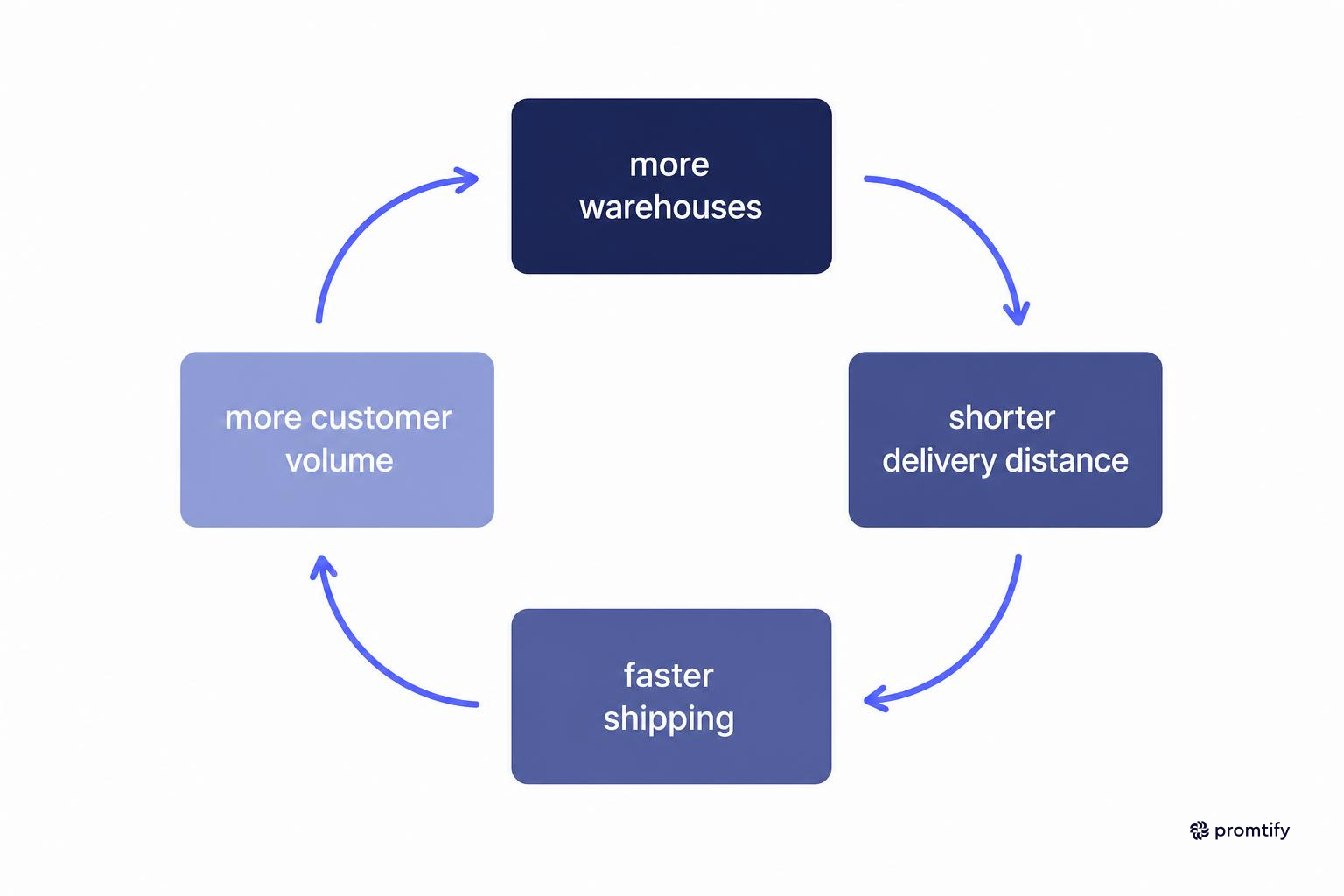
Amazon's competitive advantage rests heavily on its logistics network, built over years through direct investment in warehouses, delivery fleets, and last-mile infrastructure. This lets Amazon offer delivery speeds that smaller retailers cannot match without similarly large capital investment. The infrastructure itself, not the website or app, is the actual asset that competitors would need to reproduce, and physical infrastructure of this scale cannot be built quickly regardless of how much capital a competitor has available.
The advantage compounds over time. More warehouses mean shorter delivery distances, which support faster shipping, which increases customer volume, which funds further warehouse expansion. This is a textbook case among companies with competitive advantage rooted in physical scale rather than branding or price alone. Each additional warehouse does not just add capacity, it also shortens the average distance to customers in that region, which improves delivery speed for everyone in the surrounding area, not just new customers signed up after the warehouse opens.
A smaller retailer cannot replicate this advantage by simply copying Amazon's website or product catalog. The advantage lives in the physical network, not the storefront, which makes it far more expensive and slower for a competitor to build. A competitor could launch a similar-looking website within months, but matching even a fraction of the physical delivery network would require years of construction, hiring, and fleet investment before the effect on delivery speed would even become noticeable to customers.
4. Toyota: Manufacturing Efficiency as a Cost Advantage
Toyota's advantage traces back to its production system, which focuses on eliminating waste at every stage of manufacturing. Techniques like just-in-time inventory and continuous process improvement reduce the amount of capital tied up in unsold parts and unfinished vehicles. Instead of stockpiling large amounts of inventory in case demand fluctuates, the system relies on precise timing between suppliers and the production line, which frees up capital that competitors often leave sitting in warehouses as unsold parts.
This is one of the clearer companies that use comparative advantage principles in a manufacturing context, producing more efficiently than competitors given the same raw inputs. The efficiency gain shows up directly in lower production costs, which supports both competitive pricing and stronger profit margins on each vehicle sold. Because the savings come from the production process itself rather than from cutting corners on materials, the cost advantage does not come at the expense of the finished product's quality, which is part of why the model has remained durable rather than being a short-term cost-cutting measure.
Other automakers have studied and adopted pieces of this system, but Toyota's advantage persists because the approach depends on decades of internal process discipline, supplier relationships, and workforce training that cannot be adopted overnight. Copying a checklist of techniques is straightforward; rebuilding the underlying culture of continuous process refinement, spread across every level of the workforce, is a far slower and more difficult undertaking that most competitors have only partially achieved.
5. Netflix: Data-Driven Content Decisions as a Differentiation Advantage
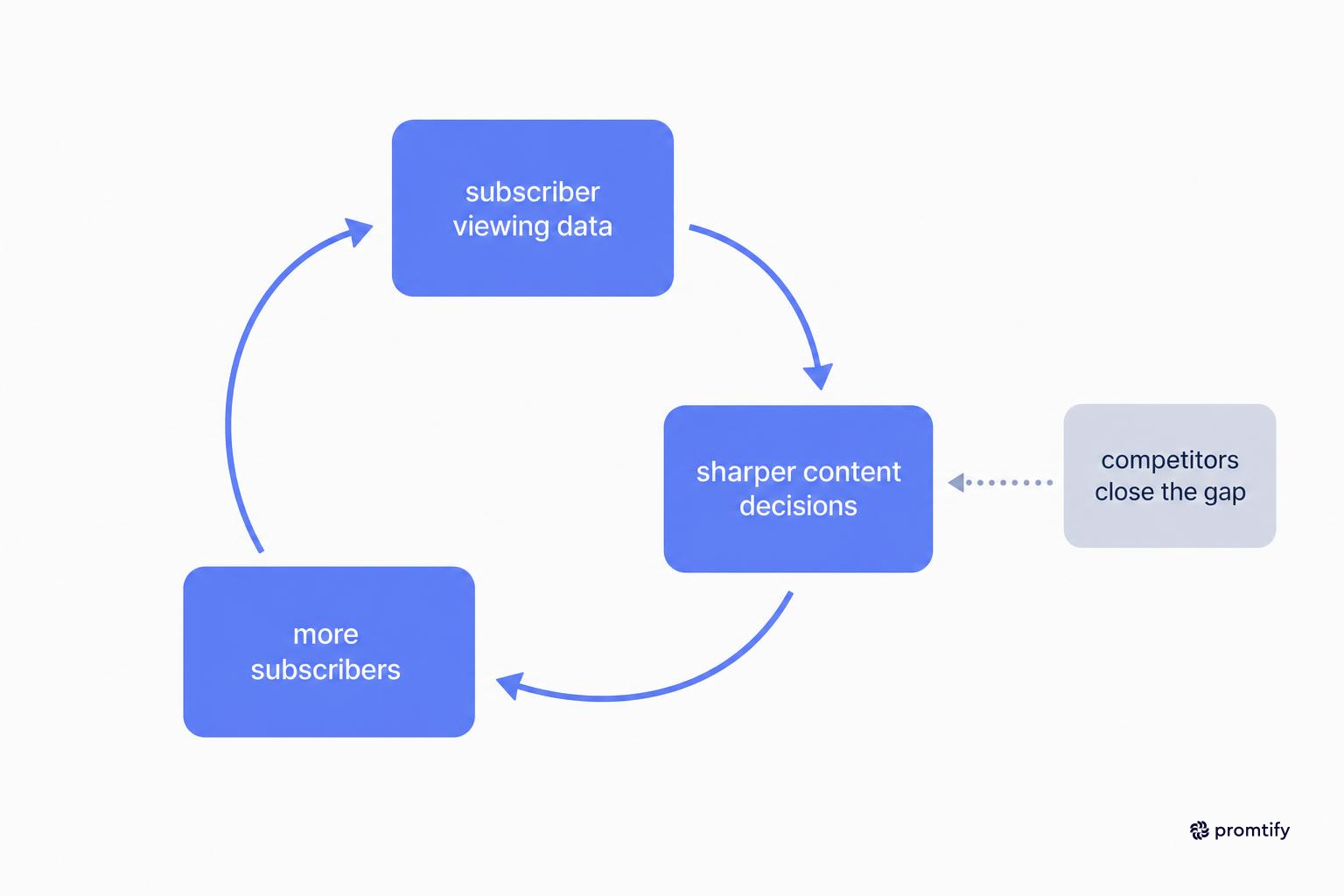
Netflix's advantage comes from combining a large subscriber base with detailed viewing data to guide content investment decisions. This reduces the guesswork involved in deciding what shows or films to produce or license, compared to studios relying primarily on market research and industry intuition. Rather than guessing what audiences might want based on surveys or past box office trends, Netflix can observe exactly what its own subscribers watch, rewatch, and abandon partway through, which produces a far more direct signal about what content decisions are likely to succeed.
The advantage strengthens as the subscriber base grows, since more viewing data leads to sharper content decisions, which attracts more subscribers in turn. This creates a feedback loop similar to a network advantage, even though Netflix's core product is not a traditional network platform. The loop does not require subscribers to interact with each other the way a social network does; it only requires enough subscribers watching enough content to generate patterns reliable enough to inform future investment decisions.
Competing streaming services collect similar data today, so this advantage has narrowed over time. It remains a useful example of competitive advantage because it shows how a data asset, not just content quality, can shape market position. This narrowing is itself an instructive detail: it demonstrates that even a strong, data-based advantage is not permanent once competitors reach a similar subscriber scale and begin collecting comparable data of their own.
6. Southwest Airlines: Operational Simplicity as a Cost Advantage
Southwest built its advantage around a single aircraft type across its fleet, which simplifies maintenance, pilot training, and parts inventory compared to airlines operating multiple aircraft models. This operational simplicity reduces costs at nearly every level of the business. Mechanics only need to be trained on one airframe, spare parts inventory does not need to be split across different models, and pilots can be scheduled across the entire fleet without model-specific certification limitations getting in the way.
The airline also uses a point-to-point route structure instead of the hub-and-spoke model common among larger carriers, which reduces layover-related delays and keeps aircraft utilization high. Higher utilization means more revenue-generating flight hours per aircraft, directly supporting lower operating costs per seat. Every hour an aircraft spends parked at a hub waiting for connecting passengers is an hour it is not generating revenue, so a route structure that minimizes that idle time translates directly into a lower cost base per flight.
This is a strong example among company advantages examples because the advantage is structural, built into route design and fleet decisions, rather than dependent on marketing or customer perception alone. A competitor cannot adopt this advantage simply by advertising low fares; it would need to redesign its entire fleet composition and route network, which involves years of transition and significant capital commitment before any cost benefit would materialize.
7. Nike: Brand Equity as a Long-Term Differentiation Advantage
Nike's advantage centers on decades of brand-building through athlete partnerships, cultural relevance, and consistent marketing investment. This brand equity allows Nike to charge premium prices for products that, in some cases, are not meaningfully different from competitors on a technical level. The premium customers pay is not always tied to a measurable performance difference in the product itself; it is tied to the meaning and status attached to the brand through years of association with athletic achievement and cultural moments.
Brand equity of this kind is difficult to copy quickly because it depends on accumulated trust and recognition built over a long period, not on any single campaign or product launch. A competitor could match or even exceed Nike's product performance in a single category within a year or two, but replicating decades of cultural association is not something a marketing budget alone can shortcut, regardless of how large that budget is.
This example highlights that not every competitive advantage comes from operations or cost structure. Sometimes the advantage lives almost entirely in customer perception, which still translates directly into pricing power and loyalty. This is worth emphasizing because it is easy to assume that competitive advantage only comes from tangible, measurable systems like logistics or manufacturing. Nike's case shows that intangible assets like reputation and cultural relevance can be just as durable, and in some cases even harder to dislodge, than a purely operational advantage.
How to Identify Your Own Competitive Advantage Using These Examples
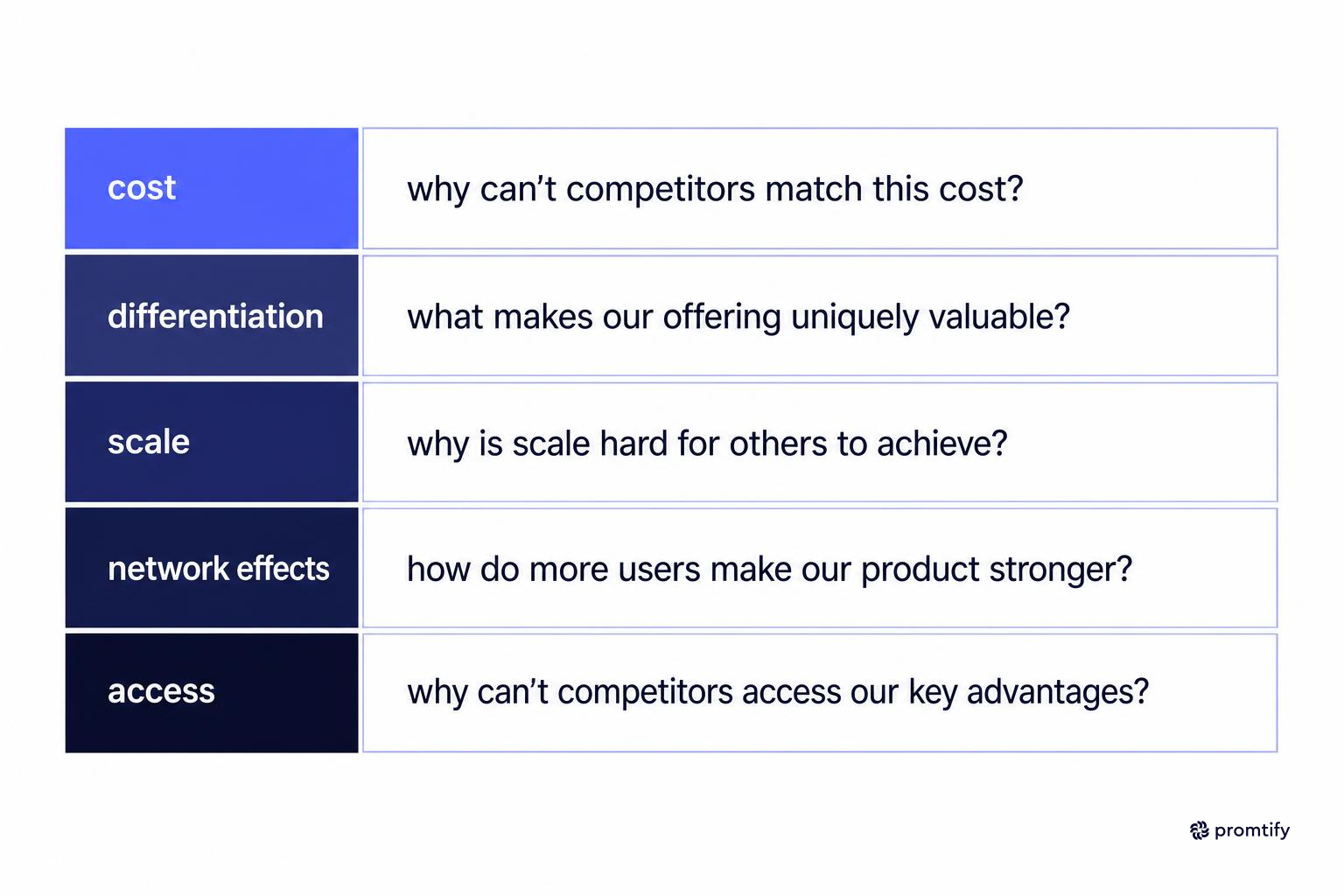
Once you understand how these seven companies with competitive advantage built their positions, the next step is applying the same lens to your own business. Start by asking which category from the earlier list best matches something your company already does differently, whether that is cost, differentiation, scale, network effects, or access. Most businesses already have the seed of an advantage somewhere in how they operate; the challenge is usually recognizing it clearly enough to describe it in structural terms rather than vague marketing language.
A useful exercise is to walk through each of the five advantage categories and ask a specific question for each one. For cost, ask whether you produce or deliver something at a lower cost than competitors given the same quality, and if so, why competitors cannot easily match that cost. For differentiation, ask what customers would lose, specifically, if they switched to a competitor, beyond a general sense of preference. For scale, ask whether your size gives you leverage over suppliers, pricing, or data that a smaller competitor genuinely cannot access. For network effects, ask whether your product becomes more useful as more people use it, or whether usage is essentially independent between customers. For access, ask whether you hold any license, relationship, or exclusive arrangement that a competitor is legally or contractually blocked from copying.
Avoid the common mistake of listing something you are proud of rather than something competitors genuinely cannot copy. A fast support team is nice, but if a competitor can hire the same kind of team next quarter, it is not a durable advantage. The same applies to things like "great culture" or "passionate team," which may be true and valuable internally but rarely function as a competitive advantage in the market sense, since they do not directly change customer behavior or cost structure in a way that is hard to reproduce.
Once you have a candidate advantage, stress-test it the way the seven examples above hold up to scrutiny. Ask how long it would take a well-funded competitor to build the same thing from scratch, and ask whether copying only the visible surface of it, without the underlying structure, would still produce the same effect. If a competitor could replicate the visible part quickly and still get most of the benefit, the advantage is weaker than it appears, and it is worth digging further into what the underlying structural piece actually is.
If you want a structured way to work through this, this framework for identifying your key competitive advantage walks through the process step by step, using additional examples alongside a repeatable method.
Common Mistakes When Trying to Copy a Competitor's Advantage
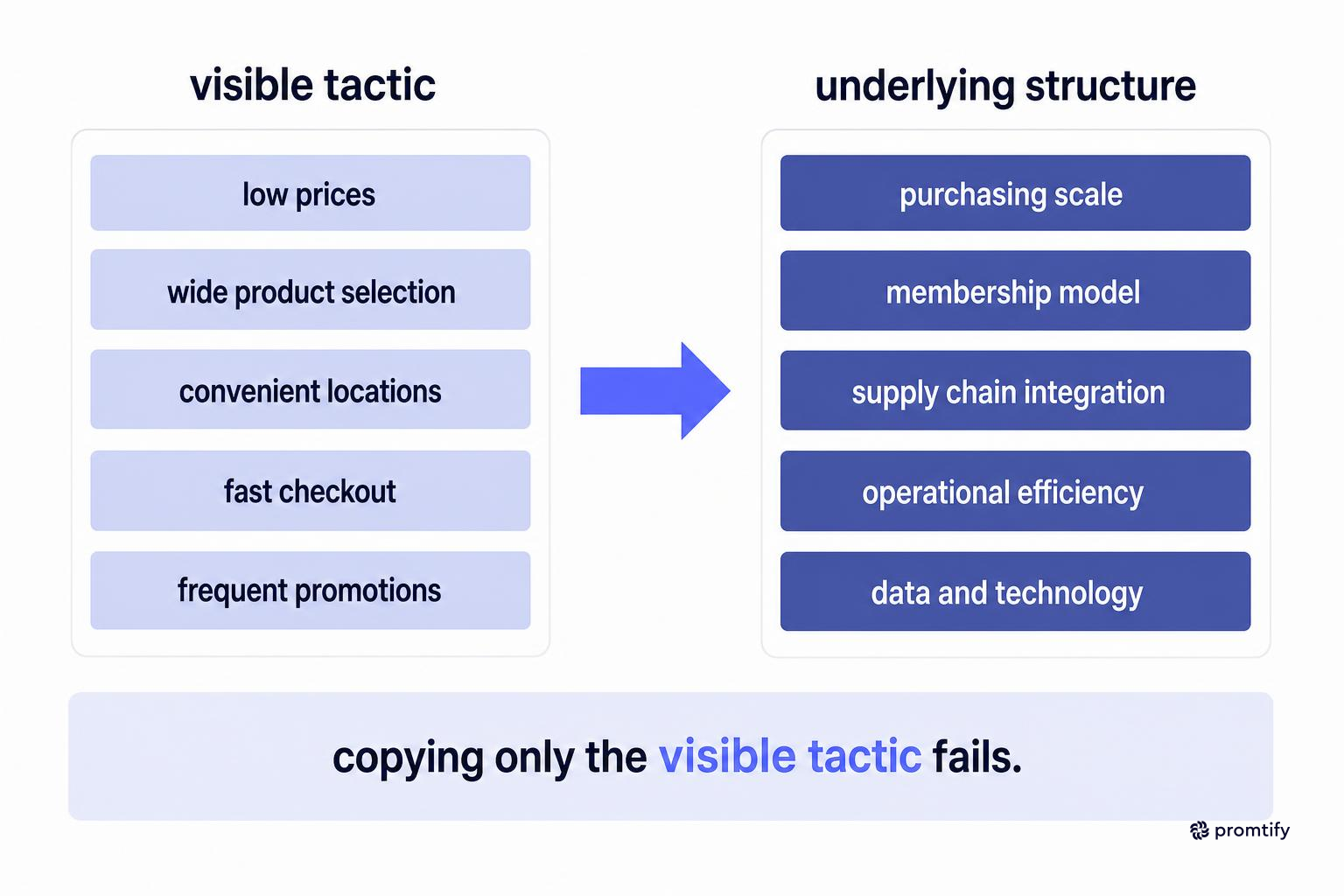
Many businesses try to replicate a competitor's advantage by copying the visible tactic rather than the underlying structure. Copying Costco's low prices without copying its membership model or purchasing scale, for example, usually just compresses your own margin without producing the same customer loyalty effect. The price cut is visible and easy to imitate, but the negotiating leverage and psychological loyalty effect behind it are not, which means the imitation captures none of the benefit while absorbing all of the cost.
Another common mistake is assuming an advantage is permanent. Netflix's data advantage narrowed as competitors built their own subscriber bases and data systems, which shows that even strong advantages require ongoing investment to maintain. Treating an advantage as a fixed asset rather than something that needs continuous reinforcement is one of the most common reasons a once-strong market position quietly erodes over several years without any single dramatic event marking the decline.
A third mistake is confusing a competitive advantage with a value proposition. A value proposition describes what you promise customers, while a competitive advantage describes why competitors cannot deliver the same promise as easily. Teams frequently write strategy documents listing their value proposition and mistakenly label it a competitive advantage, without ever answering the harder question of why a competitor could not simply promise the same thing tomorrow. If you are unsure which one you are actually describing, this comparison of competitive advantage vs value proposition clarifies the distinction with practical examples.
A fourth, less obvious mistake is trying to build multiple unrelated advantages at once rather than focusing resources on strengthening one that already shows signs of working. Companies with competitive advantage in the examples above generally did not pursue every category simultaneously from day one; they built strength in one area first and layered additional advantages on top only once the first one was established and defensible.
Applying Competitive Advantage Thinking to Small and Niche Businesses
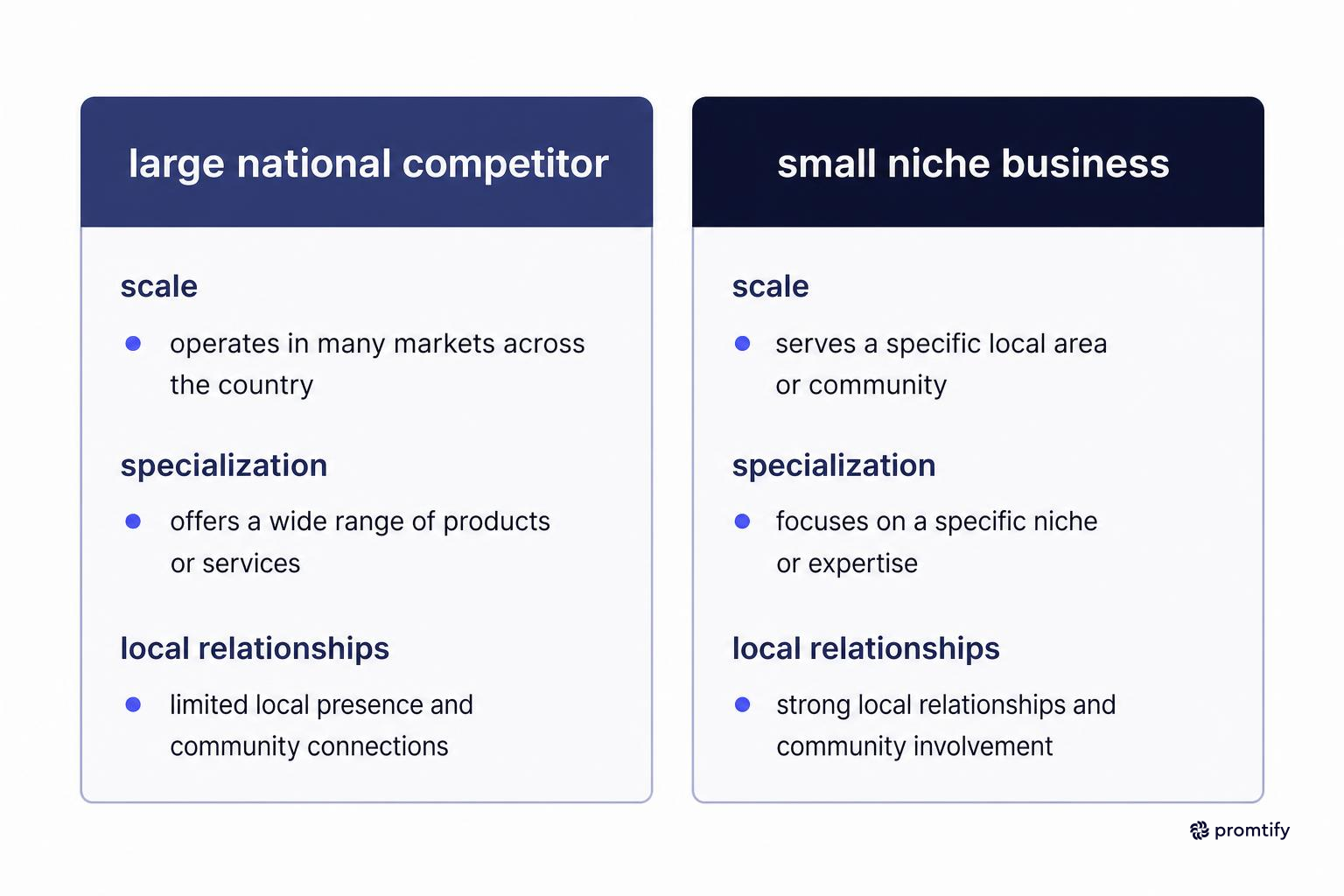
Smaller businesses often assume that competitive advantage only applies to companies with the scale of Amazon or Costco. In practice, niche businesses can build advantages the same way, just at a smaller scope, often through specialization, local relationships, or a narrow customer segment that larger competitors ignore. The mechanisms are the same, only the scale changes: a specialized local business can build a version of a differentiation advantage or an access advantage without needing the capital that a scale advantage would require.
A local business that knows its regional customer base in detail can move faster and serve more specifically than a national competitor stretched across many markets. That specificity, applied consistently, becomes a real advantage even without Amazon-level infrastructure behind it. A national competitor optimizing for broad appeal across many regions often cannot justify the operational cost of tailoring its offering to a single local market the way a business focused entirely on that market can, and that gap in attention is exactly where a smaller business can build a defensible position.
Small businesses can also apply the same stress-test used earlier for larger companies. Ask whether a larger competitor entering your market could copy your specific advantage without sacrificing the efficiency that makes their scale valuable elsewhere. Often, the answer is no, because the very specialization that gives a small business its edge would be uneconomical for a larger competitor to replicate across every market it operates in, which is precisely why the advantage holds even against a much larger rival.
For a closer look at how smaller companies build defensible positions without large-scale resources, this guide on niche competitive advantage for small businesses outlines a practical approach for identifying and defending a narrow market position.
Using Language That Fits Your Advantage
Once you identify your advantage, how you describe it matters almost as much as the advantage itself. Terms like differentiator, unique strength, or strategic edge all describe similar ideas, but choosing the right term for your audience, whether investors, customers, or internal teams, changes how clearly the message lands. An investor deck might benefit from language emphasizing defensibility and moat-like qualities, while customer-facing language usually needs to translate the same underlying advantage into a benefit the customer directly experiences, rather than describing the internal mechanism itself.
Internal teams, by contrast, often need the most precise and mechanical description of the advantage, since they are the ones responsible for protecting and reinforcing it day to day. A sales team describing your advantage in vague terms to prospects is a sign that the internal language used to define it was too abstract in the first place, which is worth correcting before it spreads further through customer-facing materials.
If you are drafting positioning language and want alternative phrasing that still communicates the same underlying concept, this list of competitive advantage synonyms and alternative terms offers options along with guidance on when each term fits best.
Turning These Examples Into a Repeatable Strategy Exercise
The real value in studying companies with competitive advantage is not the trivia itself, it is building a habit of asking the same structural questions about your own business on a regular basis. Markets shift, competitors adapt, and an advantage that felt secure two years ago can erode without anyone on the team noticing until revenue reflects it. Netflix's narrowing data advantage is a reminder that this erosion rarely happens all at once; it happens gradually, through small competitor moves that only become visible in hindsight once the cumulative effect shows up in the numbers.
A useful practice is revisiting your competitive advantage analysis on a fixed schedule, comparing it against what competitors have started doing since your last review. Treat it as an ongoing exercise rather than a one-time strategy document that sits unused after the initial workshop. Each review should ask not only whether the advantage still exists, but whether competitors have made visible progress toward closing the gap, even if they have not fully closed it yet.
Teams working through this kind of analysis with AI tools often lose the reasoning behind earlier conclusions once the conversation ends. Promtify addresses this by letting you save that context as a Markdown file, so the assumptions, competitor research, and framework decisions from one analysis session carry forward into the next, whether the next person reviewing it is a teammate or an AI agent picking up the task later.
This matters specifically for competitive advantage work because the analysis rarely happens in one sitting. New examples surface, competitor moves change the picture, and having a persistent, versioned record through Promtify means each review builds on the last one instead of starting the reasoning over from scratch.


